
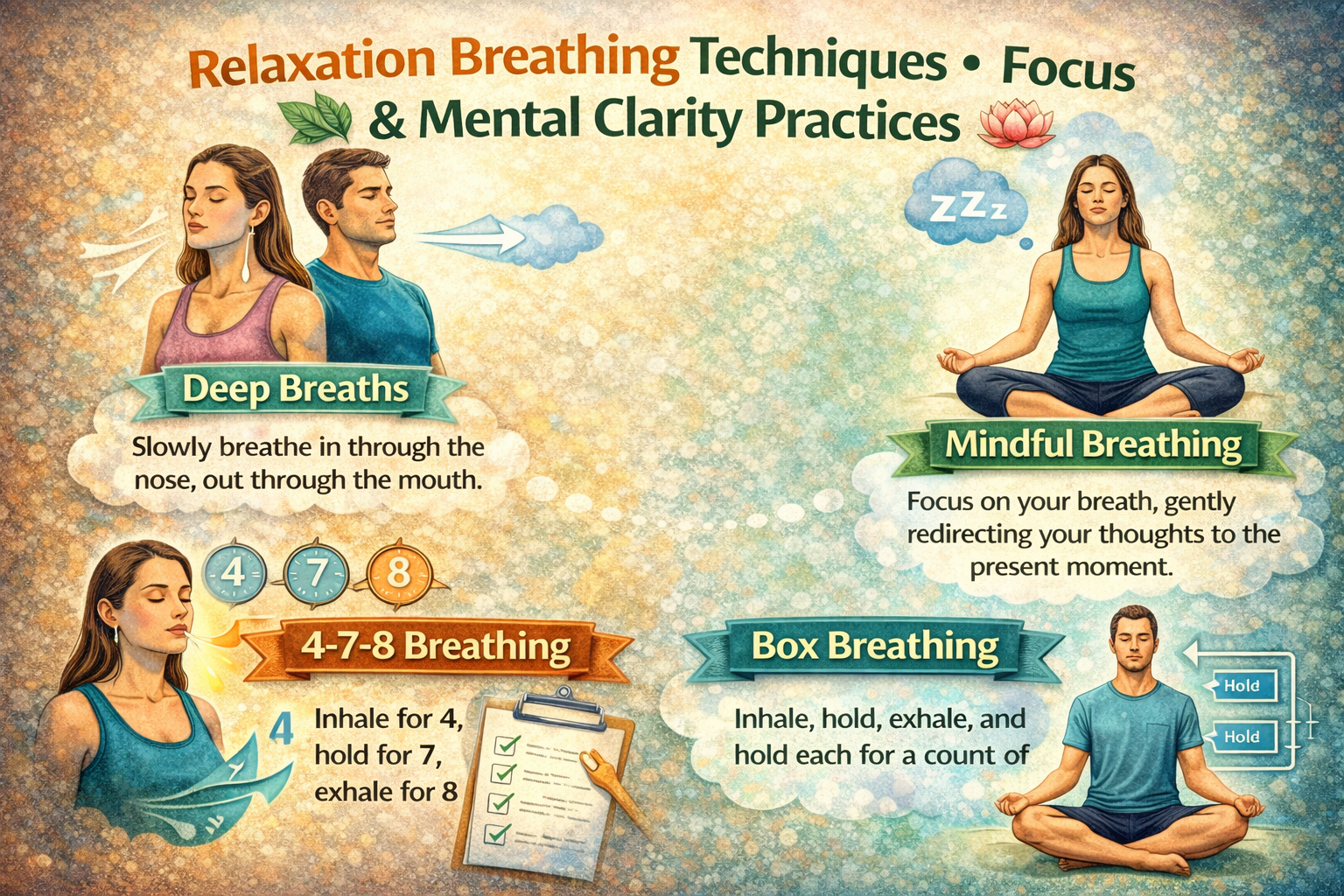
Concentration is not just a mental skill. It is a physiological state. When breathing becomes shallow and irregular, attention often fragments. When breathing is steady and controlled, mental clarity tends to follow.
Controlled breathing exercises designed for focus do not aim to create drowsiness. Instead, they balance alertness with calm. One effective technique is “box breathing,” sometimes used in high-performance environments. The structure is simple: inhale for four counts, hold for four, exhale for four, hold for four, and repeat.
The brief pauses create structure. That structure gives the mind something predictable to follow. Attention shifts from scattered thoughts to a measured cycle. This rhythm can help reduce mental noise before important tasks such as studying, writing, or presentations.
Another approach is nasal breathing with upright posture. Nasal breathing naturally regulates airflow and supports efficient oxygen exchange. Sitting upright allows the diaphragm — the primary breathing muscle — to move freely. When the diaphragm works properly, breathing becomes smoother and more energy-efficient.
It is important to clarify what breathing practices are and are not. They are not a substitute for medical or psychological care. They are not performance “hacks” that guarantee success. They are tools for self-regulation. Used consistently, they may support improved awareness and task engagement.
A simple pre-work routine might look like this: sit still for three minutes, practice box breathing, then immediately begin your task without checking your phone. The breathing acts as a mental transition — a signal that it is time to focus.
Over time, your brain may begin to associate that breathing pattern with productivity. In neuroscience, this is called conditioning. Repetition builds associations. Associations build habits.
Breath becomes a bridge between body and cognition. It is not dramatic. It is not mystical. It is simply physiology applied with intention.